
 E-Paper



Ahead of Eid, loudspeaker politics rages across states
Alvida ki Namaz is the last Friday prayer in the holy month of Ramzan and comes a few days before Eid celebrations.


The politics over loudspeakers at religious places, particularly mosques, gained momentum on the eve of Friday’s “Alvida ki Namaz” with close to 22,000 loudspeakers being removed in Uttar Pradesh, Madhya Pradesh home minister Narottam Mishra promising a regulation to deal with loudspeakers, and Karnataka government authorising police station chiefs to hold discussions with religious body heads on restricting their use.
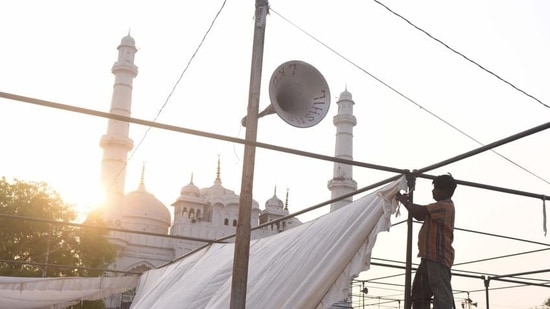
Alvida ki Namaz is the last Friday prayer in the holy month of Ramzan and comes a few days before Eid celebrations. Loudspeakers are used by mosques for the Azaan, or calling the faithful for prayers, five times a day. They are also used by temples for Hanuman Chaalisa recitations in the morning and evening hours.
The controversy over use of loudspeakers at mosques comes after call for ban on wearing Hijab in educational institutions, sale of Halal meat around Hindu religious places in Karnataka, boycott of Muslim traders and use of bull-dozers against alleged encroachments by those involved in communal riots, adding to communal tension.
The loudspeaker saga began when Maharashtra Navnirman Sena (MNS) leader Raj Thackeray, during a Gudi Padwa festival rally on April 2, gave an ultimatum to the Maharashtra government to remove loudspeakers from mosques by May 3, or the Hanuman Chalisa would be read outside these mosques using loudspeakers to drown out the sound of the Azaan. The Maharashtra government reacting strongly, saying they will not allow anything to vitiate the state’s peace, and refused to come out with regulations on restricting use of loudspeakers for Azaan.
The issue spiralled when Amaravati independent MP, Navneet Rana, and her MLA husband Ravi Rana, said they would recite Hanuman Chalisa outside Maharashtra chief minister Uddhav Thackeray’s family home. On April 23, the couple were arrested while they were on their way to Matoshree and booked for creating animosity between different religious groups. They have been sent to judicial custody for 14 days on Sunday.
Even as the high drama continues to play out in the Maharashtra, several Bharatiya Janata Party (BJP)-ruled states have backed the need to enforce regulations on the use of loudspeakers at religious places. Some of them -- including Uttar Pradesh, Madhya Pradesh and Karnataka -- have asked local authorities to enforce the Supreme Court orders on managing noise levels in residential areas and not allowing use of loudspeakers between 10pm. and 6am. As per the Central Pollution Control Board norms, a noise level of up to 55 decibels is allowed during the day, and up to 45 decibels at night.
Police has been authorised in some places to take action against those violating in the noise level norms. To be sure, the rules are also being applied to temples across the states that have enforced them.
Here, is a look on how the issue is playing out across some key states.
Uttar Pradesh
On April 19, Uttar Pradesh chief minister Yogi Adityanath told officials to ensure that loudspeakers at religious places should not cause “inconvenience” to others, following a row over Azaan and Hanuman Chalisa recitation on loudspeakers defying the norms.
On April 23, the UP home department issued orders for removal of loudspeakers from religious places or using them within the pollution control norms and sought compliance report by April 30.
Before the official order was issued, a loudspeaker atop the Sri Krishna Janmabhoomi in Mathura was muted on April 20. As a result, the “Manglacharan Aarti” held for an hour from 5am, was not broadcast through the loudspeaker at Bhagwat Bhavan on the Sri Krishna Janmabhoomi premises.
On Wednesday, Shaktipeeth Devipatan Tulsipur Temple in Balrampur removed three out of four loudspeakers and reduced the volume of one to permissible limits. Temple Mahant Mithilesh Nath appealed to all religious leaders to follow suit.
“We welcome chief minister Yogi Adityanath’s order regarding limiting the volume of the loudspeakers,” said Maulana Yasoob Abbas, a Shia cleric and general secretary All India Shia Muslim Personal Law Board (AISMB). Sunni cleric Maulana Khalid Rasheed Farangi Mahali, Imam of the Lucknow Eidgah, too, issued a video urging the Sunni mosques to limit the loudspeakers on Alvida and on the day of Eid.
Till Thursday, home department officials said close to 21,963 loudspeakers were removed across the state, and volume control instruments were installed in 42,332 loudspeakers, senior UP government officials said.
“The people have done this of their own free will. All religious leaders have also welcomed this order,” UP Police Additional Director General (ADG), Law and Order, Prashant Kumar said on Thursday.
Expert quote on the politics and the link to Friday’s prayers.
Karnataka
The Karnataka government has authorised police to take action against religious places and commercial establishments that don’t adhere to Noise (Pollution and Control) Regulation, 2010, of the Central Pollution Control Board, advising police to make institutions adhere to the norms before taking action.
As the first step, police has issued notices informing these places about the regulation and the need to adhere to noise levels. In Bengaluru alone, 400 notices have been issued -- of which 236 were to mosques , temples (83), churches (22), and other religious places. Close to 10,000 notices have been issued so far across the state, a state home department official said.
Of them, 125 notices were issued to mosques, 83 to temples, 22 to churches, 59 to commercial establishments including pubs and bars, and 12 to industries.
Karnataka home minister Araga Gyanendra on Wednesday said a most institutions have voluntarily reduced the volume, and police have been asked to check whether the levels are within the permissible limit. “We are just ensuring that everyone follows Supreme Court orders,” he said.
The Supreme Court has ordered that no loudspeakers should be allowed between 10 p.m. and 6 a.m. and has asked state governments to enforce the CPCB noise permissible levels.
Last Friday, state chief minister Basavaraj Bommai said the issue of the use of loudspeakers for Azaan should be sorted out harmoniously by organising peace committee meetings. “Instructions had already been issued based on a court order to maintain decibel levels at places of worship and police had been instructed not to allow the matter to escalate into a law-and-order problem,” he said.
Madhya Pradesh
State home minister Narottam Mishra on Tuesday said the government will come out with regulations on use of loudspeakers after BJP MP from Bhopal Pragya Thakur demanded restriction on use of loudspeaker on mosques and praised UP CM Yogi Adityanath for bringing a regulation to manage noise level from loudspeakers. Several Hindu organisations in the state threatened to recite Hanuman Chalisa outside mosques, if loudspeakers are not removed from Muslim religious places.
A home department official on Thursday said that the state government will issue an order similar to UP where the district authorities would be asked to enforce the Supreme Court regulations on noise levels and request people managing religious and places to either remove loudspeakers or fix the maximum volume to the permissible level. “We have information that many have already reduced the volume voluntarily,” the official said.
Maharashtra
Uddhav Thackeray’s Maharashtra Vikas Aghadi (MVA) government is expected to issue a fresh set of guidelines for the regulation of loudspeakers at religious places in the state, or ask police stations for the implementation of the existing guidelines issued from time to time, officials said. The Nashik police commissioner, on April 17, issued an order in which it is mandatory to seek permission before the use of loudspeakers from May 3.
The Maharashtra government held an all-party meeting to discuss regulation on use of loudspeakers. Barring MNS, all other parties demanded strict implementation of the existing orders on regulation of loudspeakers. The BJP boycotted the meeting.
Former chief minister and BJP leader Devendra Fadnavis chided the chief minister Uddhav Thackeray on his government’s stand on loudspeakers and said he has joined the queue of pseudo seculars. “He doesn’t take action on loudspeakers even after HC order but when ‘Hanuman Chalisa’ is played on loudspeakers, it’s seized. It means Uddhav Thackeray has joined politics of pseudo-secular,” Fadnavis said at an event to mark the BJP’s Foundation Day in first week of April.
“The environment and home department have issued various guidelines from 2015 to 2017 based on the Supreme Court orders issued in 2005. The orders have clearly mandated the need for the permission for the use of loudspeakers at all the religious places and their noise levels. We will discuss the issue in the state cabinet to take a call on whether to issue fresh guidelines or to ask the authorities to rigorously implement the standing orders,” home minister Dilip Walse Patil said after the meeting on Monday.
According to a survey conducted by police, about 72% of mosques in Mumbai have reduced the volume of loudspeakers during morning Azaan, while many have even stopped using it. Muslic clerics such as Mohammed Saeed Noori, secretary general of All India Sunni Jamiyatjul Ulama, has appealed to all mosque trusts to adhere to the government orders on loudspeakers.
Other states
In the Congress-ruled Rajasthan, the Ajmer district administration has banned use of loudspeakers at public and religious places. The Haryana government has also asked police to strictly enforce Supreme Court-mandated norms on noise pollution from use of loudspeakers. In Uttarakhand, another BJP-ruled state, several Hindu organisations have demanded ban on use of loudspeakers at mosques. However, the Uttarakhand government is yet to issue any order. No specific orders have been issued by governments of Himachal Pradesh, Punjab, West Bengal and Jharkhand for use of loudspeakers.
Secretary of Motilal Nehru Trust, Lucknow , Rajesh Singh said the unauthorised loudspeakers installed at religious sites across Uttar Pradesh are being removed on the order of the court. The court has also ordered to reduce the volume of the loudspeakers to permissible limit, he said.
“The people belonging to all communities have welcomed the drive launched by the state government to remove the loudspeakers from religious sites and reduction in its volume as well. There has been no report of resistance or violence during the drive launched by the administration to remove the loudspeakers in the 75 districts,” he said.
“The high-decibel sound of the loudspeakers disturbs the people staying in the residential areas or moving in the public places. The devotees who wish to participate in the aarti organized in the temple or Azaan in the mosque should visit the respective religious sites to hear it. In the Gulf countries and Saudi Arabia the volume of loudspeakers is not permitted above the permissible level,” Singh said.
(With inputs from bureaus in Bengaluru, Shimla and Dehradun)


